
C’est un deux en un : appareil photographique et chambre noire ! Grâce à cette boîte, on prend une photo sur du papier photo, que l’on développe à l’intérieur.
It’s a two-in-one: a camera and a darkroom! Due to this box, you take a photo on photo paper, which you develop inside.
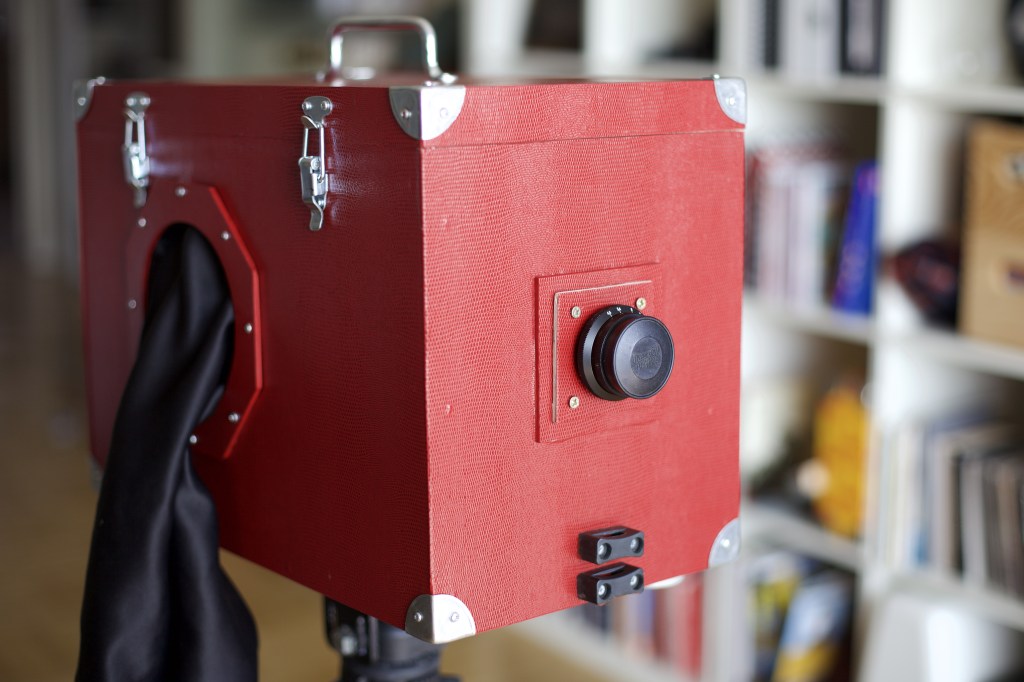
L’Afghan Box désigne une boite en bois, munie d’un objectif, ayant deux fonctions : appareil photo et chambre noire. A l’intérieur de la boite, hermétique à la lumière, une plaque de verre dépolie est amovible et permet de faire la mise au point sur le sujet placé devant la boite. La mise au point s’effectue en regardant à travers le verre dépoli, par une porte ouverte à l’extrémité de la boite.
The Afghan Box refers to a wooden box, equipped with a lens, serving two functions: a camera and a darkroom. Inside the light-sealed box, a removable ground glass plate allows focusing on the subject placed in front of the box. Focusing is done by looking through the ground glass, through an open door at the end of the box.

Une fois la mise au point faite, du papier photo est placé sur le verre et le sujet est exposé : le photographe place son papier sur le verre en rentrant sa main par le manchon qui est sur le côté.
Once the focus is achieved, photo paper is placed on the glass, and the subject is exposed: the photographer positions the paper on the glass by inserting his hand through the sleeve on the side.

Une fois l’exposition terminée, le papier est développé à l’intérieur de la boite, munie d’un bac de révélateur et d’un bac de fixateur. La place étant réduite à l’intérieur de la boite, il n’y a pas de bain d’arrêt.
After the exposure, the paper is developed inside the box, equipped with a developer tray and a fixer tray. Due to the limited space inside the box, there is no stop bath.
Travaillant sur du papier photo classique, la photo réalisée est un négatif.
Working with conventional photo paper, the resulting image is a negative.

Pour obtenir le positif, il convient de prendre en photo ce négatif, selon le même procédé.
To obtain a positive image, it’s necessary to photograph this negative using the same process.
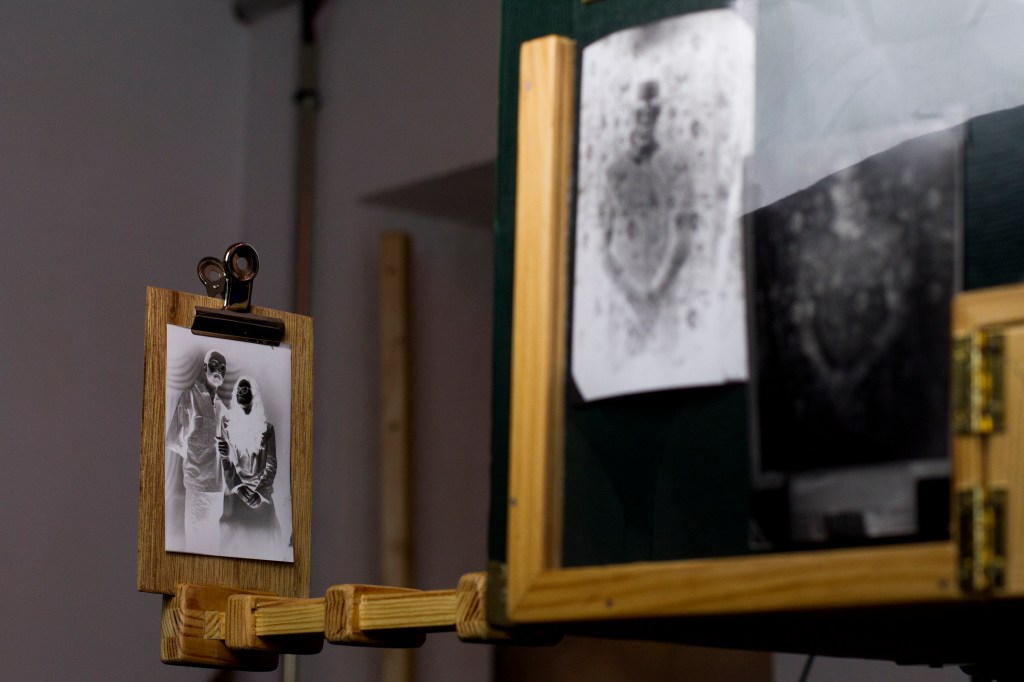
Cette fois, le négatif est placé devant la boite, pris en photo sur du papier qui est développé dans la boite.
This time, the negative is placed in front of the box, photographed on paper, and developed inside the box.

Pourquoi Afghan Box ?
Le nom utilisé s’explique par la pratique courante qui en est faite par les photographes de rue en Afghanistan, où d’ailleurs elle prend le nom de Kamra-e-faoree. Toutefois, ce n’est pas là son seul lieu de développement. Elle existe en Afrique, à Cuba, …, d’où les différents noms que l’on peut trouver : Cuban Polaroïd, Chambre Gabonaise, Lambé Lambé, Camera Minutera.
On trouve des informations passionnantes sur la pratique qui en faîte en Afghanistan ici : https://www.afghanboxcamera.com
En Europe, les photographes de rue recourant à cette pratique photographique sont de plus en plus nombreux. Parmi les français, Sébastien Bergeron a contribué à développer la pratique puisqu’il fabrique et vend de magnifiques boîtes .
Why Afghan Box ?
The name used is explained by the common practice among street photographers in Afghanistan, where it’s also known as Kamra-e-faoree. However, this is not its sole place of development. It exists in Africa, in Cuba, …, hence the various names that can be found: Cuban Polaroid, Chambre Gabonaise, Lambé Lambé, Camera Minutera.
You can find fascinating information about the practice of it in Afghanistan here : https://www.afghanboxcamera.com
In Europe, street photographers using this photographic practice are becoming more numerous. Among the French, Sébastien Bergeron has contributed to developing the practice as he manufactures and sells beautiful boxes.

 My Chromatic World
Laisser un commentaire